
Scaling Creates Interpretation Risk.
A company does not present itself to everyone in the same way.
A prospect may begin with a Google search. An investor may read the website and leadership commentary. A potential employee may look at LinkedIn, Glassdoor, and job descriptions. A partner may rely on sales materials and conversations. An existing customer may judge the company primarily through its product and service experience. An AI system may assemble an answer from information distributed across the public web.
Each encounters only part of the organization. And each may reach a different conclusion.
That creates interpretation risk: the possibility that different stakeholders encounter different evidence and form materially different understandings of who the company is, what it does, and why it matters.
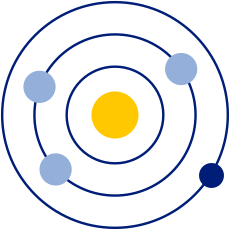
Organizations intend one meaning. Stakeholders may construct several.
01
Stakeholders enter through different doors.
There is no single customer journey through organizational meaning.
People may first encounter the company through:
- Search results
- The corporate website
- Product pages
- Social media
- Analyst or media coverage
- Customer reviews
Each starting point provides a different sample of the organization.
The question is whether those different entry points lead toward a recognizable understanding of the same company.
Different pathways should not require different explanations of who you are.
02
Different audiences look for different evidence.
A customer may ask: Will this solve my problem?
An investor may ask: Why can this company win?
An employee may ask: What kind of organization is this?
These audiences do not need identical information.
But the evidence they encounter should support compatible conclusions about the organization’s value, priorities, capabilities, and position.
Different questions can still lead to a coherent meaning.
03
No stakeholder sees the complete organization.
Leadership has access to context outsiders do not.
Leaders know the strategy, history, rationale behind decisions, intended positioning, and future direction. External audiences usually do not. They infer. They interpret what is available to them and fill in what is missing.
That creates an important asymmetry: What feels obvious inside the organization may be difficult to infer from outside it.
A leadership team can therefore be quite clear about what the company means while the market remains uncertain.
Internal clarity does not guarantee external understanding.
04
Public information can preserve older versions of the company.
Organizations change faster than their information environments sometimes do.
A company may enter a new market, change its positioning, launch a new offering, redefine its customer focus, or alter its strategy.
But older descriptions may remain across:
- Web pages
- Press releases
- Partner sites
- Executive biographies
- News coverage
The organization may have moved forward. Its information environment may still contain evidence of several earlier versions. Stakeholders must decide which version represents the company today.
Meaning can fragment across time as well as across channels.
05
AI increases the importance of coherent public evidence.
People increasingly encounter companies through systems that interpret information on their behalf.
AI tools do not attend the strategy meeting.
They work from the information they can access.
If public evidence describes the organization consistently, an AI system has a stronger basis for identifying what the company does, how it should be categorized, whom it serves, and why it may be relevant.
If the evidence is incomplete or contradictory, the company may be represented inconsistently—or may not surface when it should.
This creates a newer form of interpretation risk.
The company must be understandable not only to people who visit its website, but also to systems interpreting information across multiple sources.
A company cannot assume that every interpretation begins on its homepage.
06
Category ambiguity is especially consequential.
Stakeholders need some way to place a company in context.
What kind of organization is this? What problem does it solve? What alternatives should I compare it with? Who is it intended for?
A company may resist being placed into a familiar category because its offering is distinctive.
But if people cannot determine the appropriate context, differentiation becomes difficult to understand.
The same company might be interpreted as:
- A technology platform by one audience
- A consulting service by another
- A data provider by another
- A specialized solution within a completely different category by someone else
Those interpretations lead to different expectations, competitors, value comparisons, and buying criteria.
Before people can understand why you are different, they need enough context to understand what you are.
07
Interpretation risk is not the same as message inconsistency.
An organization can use consistent language and still be interpreted differently. The issue is broader than whether the same tagline appears everywhere. Different stakeholders draw conclusions from different evidence.
The important question is therefore not only: Are we saying the same thing?
It is: Does the available evidence lead people toward the meaning we intend?
Coherence is ultimately an outcome.
08
Leaders should look for competing versions of the company.
Interpretation risk becomes easier to recognize when leaders examine the organization from outside their own context.
Ask:
- How would a prospect describe us after seeing only our website?
- How would a customer describe us after working with us?
- How would an investor explain why we are different?
- How would a job candidate characterize our priorities?
- How do partners describe us when we are not in the room?
Perfect uniformity is neither possible nor desirable. The objective is recognizable meaning across different perspectives.
A coherent company remains identifiable even when viewed from different directions.
09
Interpretation risk must be diagnosed across sources.
You cannot understand interpretation risk by reviewing a messaging document alone.
You need to compare different forms of evidence:
- What leadership believes
- What employees and stakeholders say
- What internal materials reinforce
- What the company publishes
The gaps between these sources can be more revealing than any source individually.
They show where the organization is clear, where meaning has drifted, and where different audiences may be constructing competing interpretations.
To understand what your organization means, examine the evidence people use to interpret it.



Contents
See how your organization is being interpreted.
The Organizational Meaning Diagnostic develops a multi-source view of organizational meaning.
It begins with the Leadership Pulse to establish the internal leadership view, then deepens that understanding through stakeholder interviews, internal content review, publicly available information analysis, and relevant external evidence.
The objective is to identify where meaning is coherent, where different interpretations are emerging, and where leadership attention can strengthen clarity.