
Why Growth Often Weakens Brand Clarity
Growth is usually evidence that something is working.
More customers arrive. New people join. Products expand. Specialists take ownership. New markets, channels, and opportunities emerge.
But growth changes the organization that created the original success.
Decisions become distributed across more people. Different functions develop their own priorities and language. New offerings require new explanations. More customers encounter the company through more pathways.
The company becomes larger faster than its shared understanding necessarily develops.
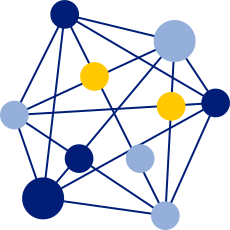
Growth expands the organization. Clarity must expand with it.
01
Growth dilutes shared context.
In a smaller organization, a relatively small group may share much of the same context.
They know why important decisions were made. They understand which customers matter most. They have lived through the development of the offering and its positioning.
Growth brings in people who were not part of those conversations.
New leaders, employees, agencies, partners, and specialists contribute valuable expertise, but they cannot rely on context they never shared. What once worked through informal understanding becomes increasingly difficult to sustain.
What was once understood implicitly must increasingly become explicit.
02
Growth creates more legitimate priorities.
As organizations expand, different functions become responsible for different outcomes.
Sales wants to win the next opportunity. Product wants to build what creates future value. Finance wants to protect economics. Customer teams want to solve immediate problems. Marketing wants to create a clear market position.
None of these priorities is inherently wrong. The challenge appears when each function interprets the company primarily through the outcomes it is responsible for delivering. Functional excellence does not automatically create organizational coherence.
03
New opportunities create new versions of the company.
Growth often requires adaptation.
A major customer asks for something different. A new segment values another benefit. A new product extends the offering. A new channel changes how the company is sold. A new geography requires different language or emphasis.
Each adaptation may be strategically sensible. But as exceptions and variations accumulate, the organization can gradually become harder to describe in one clear way.
Different teams begin answering fundamental questions differently:
What should remain consistent? Who are we really for? What problem do we solve best? What makes us different? What are we willing to customize?
Expansion creates value when variation extends the company. It creates confusion when variation begins redefining it.
04
Decision-making moves farther from its original strategic context.
Scale requires delegation.
More decisions are made by people who were not present when the original strategy, positioning, customer priorities, or value proposition were defined.
That is not a flaw. It is necessary for growth.
The problem arises when people must make important tradeoffs without a sufficiently shared understanding of the principles that should guide them.
Then reasonable decisions made in different parts of the organization can begin pulling in different directions.
As decision-making decentralizes, shared meaning becomes operating infrastructure.
05
Internal language begins to drift.
Specialization creates vocabulary. Product talks about capabilities. Sales talks about customer problems. Finance talks about economics. Marketing talks about positioning.
Different language is necessary. But it becomes a problem when the words reflect genuinely different understandings of what the company is trying to become.
One team emphasizes innovation. Another emphasizes reliability. Another emphasizes customization. Another emphasizes efficiency.
The market eventually encounters all of them. Language drift can be an early sign of meaning drift.
06
The customer encounters the accumulated result.
Customers do not see the organizational chart.
They encounter what the organization produces:
- The product
- The price
- The website
- The sales conversation
- The proposal
Each may have been shaped by a different part of the company. Customers combine them into one interpretation. When those experiences reinforce one another, growth can strengthen the brand. When they do not, growth exposes customers to more versions of the organization.
07
The warning signs appear throughout the business.
Weakening clarity may not initially look like a brand issue.
Leaders may notice:
- Different teams describing the company differently
- More exceptions to established practices
- Difficulty explaining new offerings within the existing story
- Increasing customization across customers
- Sales presentations changing significantly by seller
No single symptom proves a coherence problem. But together, they may indicate that the organization’s complexity is growing faster than its shared understanding. Growth problems sometimes begin as meaning problems.
08
Clarity must become more intentional as the organization grows.
The answer is not to prevent variation.
Growing organizations need flexibility, specialization, experimentation, and local decision-making. The challenge is to give that variation a stable center.
Leaders need shared answers to the questions that should guide decisions across the organization:
- Which customers matter most?
- What value are we committed to creating?
- What should distinguish us?
- Which tradeoffs are acceptable?
When these beliefs are clear, different functions can make different decisions while still reinforcing a coherent organization.
Early clarity can be informal. Scaled clarity must become intentional.



Contents
Understand where growth may be weakening clarity.
The Organizational Meaning Diagnostic examines whether leadership beliefs, organizational decisions, internal practices, and market-facing signals continue to reinforce a coherent understanding of the company as it grows.
The process begins with the OMD Leadership Pulse, which provides an initial view of where leaders are aligned, where interpretations diverge, and where deeper investigation should focus.