

Why Investing in Brand Pays Off in Performance

Why Investing in Brand Pays Off in Performance

Summary

Strong brands are not just marketing assets. They are economic assets.

Research consistently shows that companies with strong, differentiated brands experience:

  • Higher customer acquisition and retention
  • Greater marketing efficiency
  • Stronger pricing power
  • Higher long-term shareholder returns

These advantages emerge when leadership aligns the strategic decisions shaping how the market understands the company.

The Brand Constellations Framework helps leadership teams align those decisions across eight critical dimensions of the business—product, placement, pricing, promotion, category, competitors, company, and customers.

When these elements reinforce one another, the market understands the company more clearly. When the market understands a company clearly, customers choose it more easily.

And when customers choose more easily, growth becomes more efficient and profitable.

The Evidence Linking Brand Strength to Corporate Performance

A large body of research demonstrates that brand strength contributes directly to financial performance.

Strong brands improve customer economics

Research by Ailawadi, Lehmann, and Neslin (2003) shows that brand knowledge improves both customer acquisition and retention, while brand differentiation is positively associated with profit margins.

When customers clearly understand what a company stands for and why it is different, customer relationships become more economically valuable.

Clear brands improve marketing effectiveness

Boston Consulting Group (2023) reports that companies that underinvest in brand experience 13 percentage points lower sales growth and 6 percentage points lower awareness-to-purchase conversion rates.

When brand meaning is fragmented, companies must spend more marketing dollars to achieve the same growth.

Strong brands support pricing power

Kantar (2023) analysis shows that brand investment can reduce price sensitivity. In one case analysis, stronger brand equity enabled a 14% price increase and 7% revenue growth.

Brand strength allows companies to capture more value from their offerings.

Brand strength contributes to shareholder value

Academic research by Madden, Fehle, and Fournier (2006) found that portfolios of strong-brand companies delivered higher risk-adjusted returns than market benchmarks.

Brand strength therefore contributes not only to marketing performance, but also to enterprise value.

Why Brand Performance Happens

If strong brands produce better financial outcomes, an important leadership question follows:

What creates a strong brand?

Many organizations assume brand strength is built primarily through communication like advertising campaigns, messaging frameworks, or visual identity systems.

In reality, brand performance emerges from something deeper.

It emerges from organizational decisions.

Brand Is the Result of Strategic Decisions

A company’s brand is not created in the marketing department.

It emerges from a system of decisions made across the organization, including:

  • what products the company develops
  • which customers it chooses to serve
  • how the company defines its category
  • how it positions itself against competitors
  • how it prices its offerings
  • where and how customers encounter the brand
  • how the company communicates value
  • how the organization defines its identity

Over time, these decisions create a pattern in the market’s mind.

That pattern becomes the brand.

When these decisions reinforce one another, the market receives a clear signal.

When they conflict, the market receives noise.

The difference between signal and noise determines how easily customers understand—and choose—the company.

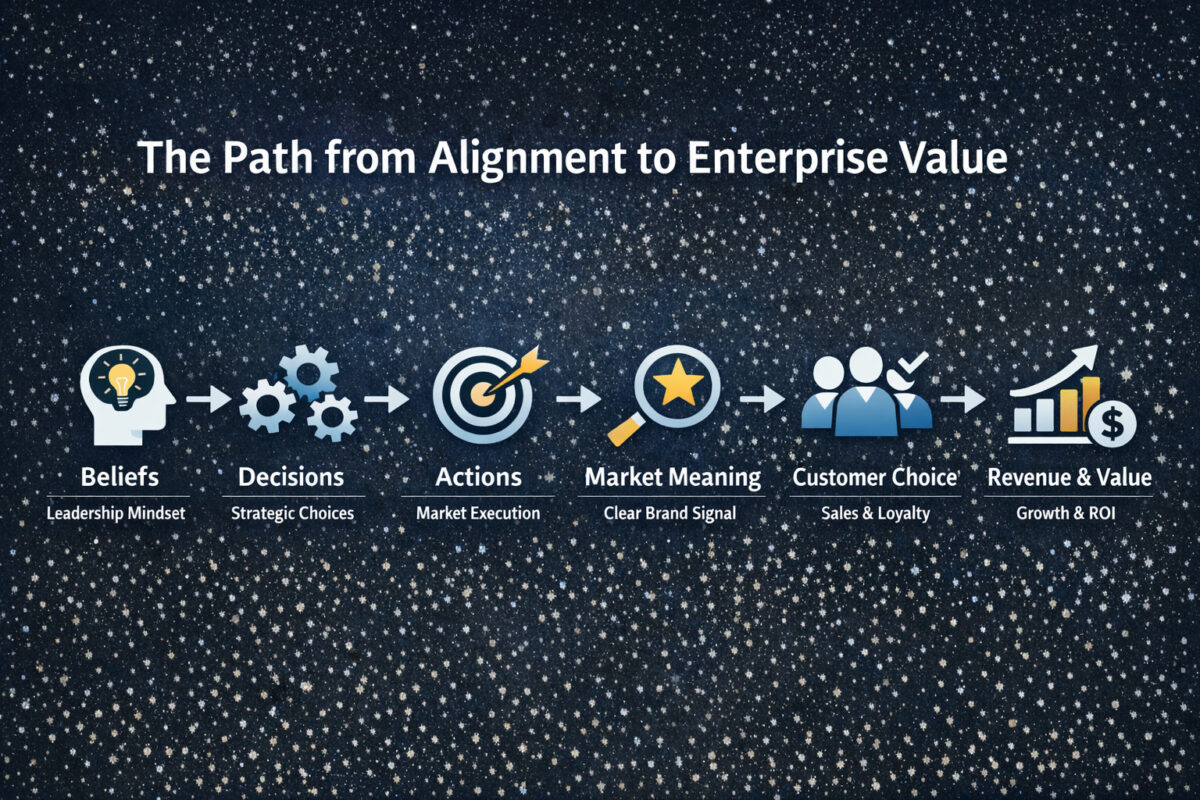
The Path from Leadership Decisions to Enterprise Value

Brand performance emerges through a chain of cause and effect.

Leadership beliefs shape strategic decisions.

Those decisions determine how the company acts in the market.

Those actions create meaning in the minds of customers.

Customer understanding drives choice, loyalty, and ultimately financial performance.

The causal chain looks like this:

Beliefs → Decisions → Actions → Market Meaning → Customer Choice → Revenue and Enterprise Value

When this chain is aligned, growth becomes easier and more efficient.

When it is fragmented, companies experience slower growth, weaker pricing power, and higher marketing costs.

The Eight Forces That Shape Market Meaning

The Brand Constellations Framework identifies eight forces that collectively shape how the market understands a company:

  1. Product – what the company delivers
  2. Placement – where customers encounter the offering
  3. Pricing -the value signal the company sends
  4. Promotion – how the company communicates its value
  5. Category – how the market frames the offering
  6. Competitors – what alternatives the company is compared against
  7. Company – the identity and character of the organization
  8. Customers – who the company serves

Each dimension sends signals to the market about what the company stands for.

When these signals align, the brand becomes clear and differentiated.

When they conflict, the brand becomes fragmented.

Fragmented brands create friction in the market. Clear brands remove it.

Why Alignment Creates Financial Advantage

When the elements of a Brand Constellation reinforce one another, several economic advantages emerge.

Customer relationships strengthen

Clear meaning improves acquisition, retention, and lifetime value.

Marketing efficiency increases

Aligned brands require less effort to communicate, improving the return on marketing investment.

Pricing power improves

Differentiated brands reduce price sensitivity and support stronger margins.

Growth becomes more efficient

Customers understand the company faster and choose it with greater confidence.

Over time, these advantages compound into stronger financial performance.

The Return on Investment in Brand Alignment

For leadership teams, the question is not whether brand matters.

The question is whether investing in brand alignment produces measurable returns.

In many cases, the economics are compelling.

Brand alignment creates value through multiple pathways.

Improved customer acquisition

Clear brand positioning improves marketing conversion and reduces the cost of acquiring customers.

Increased customer lifetime value

Customers who clearly understand and trust a brand stay longer and buy more.

Greater pricing power

Differentiated brands sustain higher prices without losing demand.

More efficient marketing investment

Aligned brands require less spending to achieve the same growth.

Even modest improvements in these metrics can generate significant financial gains when applied across a company’s customer base.

For this reason, brand alignment should be viewed not as a marketing expense, but as an investment in organizational clarity and market effectiveness.

Why Brand Constellations Is an Executive Approach

Because brand performance emerges from decisions across the organization, brand management must begin at the leadership level.

The Brand Constellations process helps leadership teams align the strategic decisions shaping their market meaning.

By mapping the eight dimensions of the brand together, companies can:

  • identify inconsistencies in how their brand is expressed
  • clarify their market positioning
  • align leadership around a coherent strategic meaning
  • guide future decisions with greater consistency

The result is not simply a stronger brand message.

It is a more coherent organization.

And coherent organizations outperform fragmented ones.

Brand Is a Strategic Investment

The research is clear: strong brands drive measurable economic outcomes.

But brand strength does not emerge by accident.

It emerges when leadership teams align the decisions shaping how the market understands their company.

When that alignment exists:

  • customers understand the company faster
  • marketing becomes more effective
  • pricing becomes stronger
  • growth becomes more efficient

Brand Constellations helps organizations build that alignment.

Because the strongest brands are not created by campaigns.

They are created by consistent decisions across the entire business.

Sources

Ailawadi, K. L., Lehmann, D. R., & Neslin, S. A. (2003). Revenue premium as an outcome measure of brand equity. Journal of Marketing, 67(4), 1–17. https://doi.org/10.1509/jmkg.67.4.1.18688

Boston Consulting Group. (2023). Rethink your brand marketing budget. https://www.bcg.com/publications/2023/rethink-brand-marketing-budget

Kantar. (2023). What if price—not volume—is your biggest growth opportunity? https://www.kantar.com/inspiration/brands/what-if-price-not-volume-is-your-biggest-growth-opportunity

Madden, T. J., Fehle, F., & Fournier, S. (2006). Brands matter: An empirical demonstration of the creation of shareholder value through branding. Journal of the Academy of Marketing Science, 34(2), 224–235. https://doi.org/10.1177/0092070305283356
Why Brand Strategy Keeps Breaking—Even When the Campaign Is Right

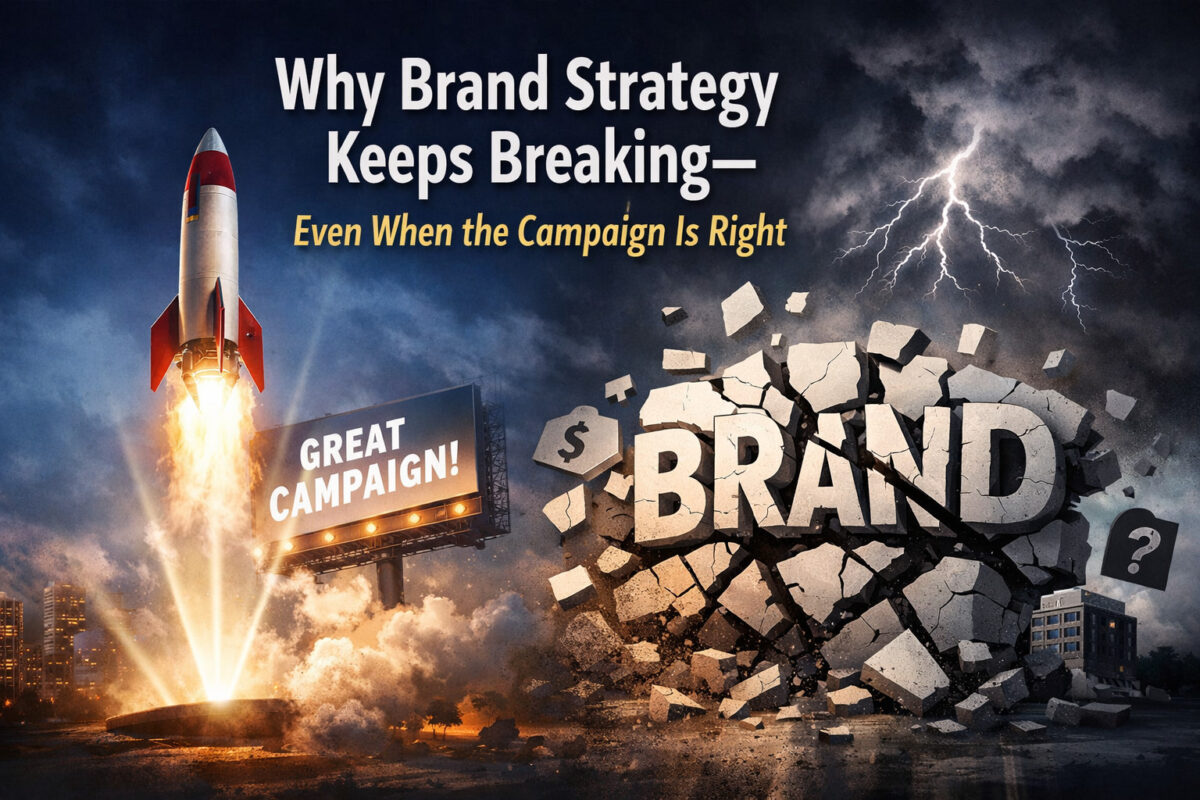
Why do so many brands invest heavily in strategy and marketing—only to feel weaker over time?

The positioning is clear.
The messaging is approved.
The campaign launches on schedule.

And yet the brand starts to blur.

Sales struggles to defend value.
Pricing feels harder to justify.
Marketing works harder for smaller gains.

The usual response is predictable: adjust the message, refresh the story, launch again.

But the problem isn’t what’s being said.

It’s what isn’t holding together.

The Real Limitation of Campaign-Based Brand Strategy

Most brand strategies are built around campaigns—linear efforts designed to persuade after decisions have already been made.

The assumption is simple:
If the message is strong enough, everything else will align.

That assumption used to work.

In a mass-media world, brands controlled the narrative. Customers encountered a limited number of signals, delivered in a predictable order. Consistency could be managed one message at a time.

That world no longer exists.

Today, customers don’t meet brands through a single storyline. They encounter them through decisions—often all at once.

And they don’t evaluate those decisions separately.

They combine them.

How Brand Meaning Actually Forms

When people think about a brand, they don’t replay its messaging. They recognize an impression.

That impression is shaped by what the brand offers, how it’s priced, where it’s available, how the company behaves, and how all of that compares to alternatives.

These signals arrive simultaneously.
They are interpreted holistically.

Which means brand meaning is not created sequentially. It emerges as a whole.

This is why brand work so often fails after it’s completed. The strategy was designed to communicate, not to cohere.

Fragmentation Is the Hidden Cost

When brands feel “confused” in the market, the instinct is to look at messaging.

But fragmentation rarely starts there.

It starts upstream, in decisions that make sense individually—but contradict each other collectively.

A premium narrative paired with tactical pricing.
A customer-first promise paired with internally driven design.
A bold category claim undermined by cautious execution.

Each decision is defensible. Together, they weaken meaning.

Marketing can amplify alignment.
It cannot repair contradiction.

And the more effort is applied downstream, the more visible the problem becomes.

Why More Campaigns Don’t Fix the Problem

When brand clarity declines, activity usually increases.

More content.
More campaigns.
More explanation.

But effort is not the same as coherence.

In fact, rising communication effort is often a signal that alignment has already broken down.

This is why some brands feel busy but not decisive. They are trying to persuade the market of something their decisions no longer reinforce.

A Necessary Shift in How Brand Strategy Is Built

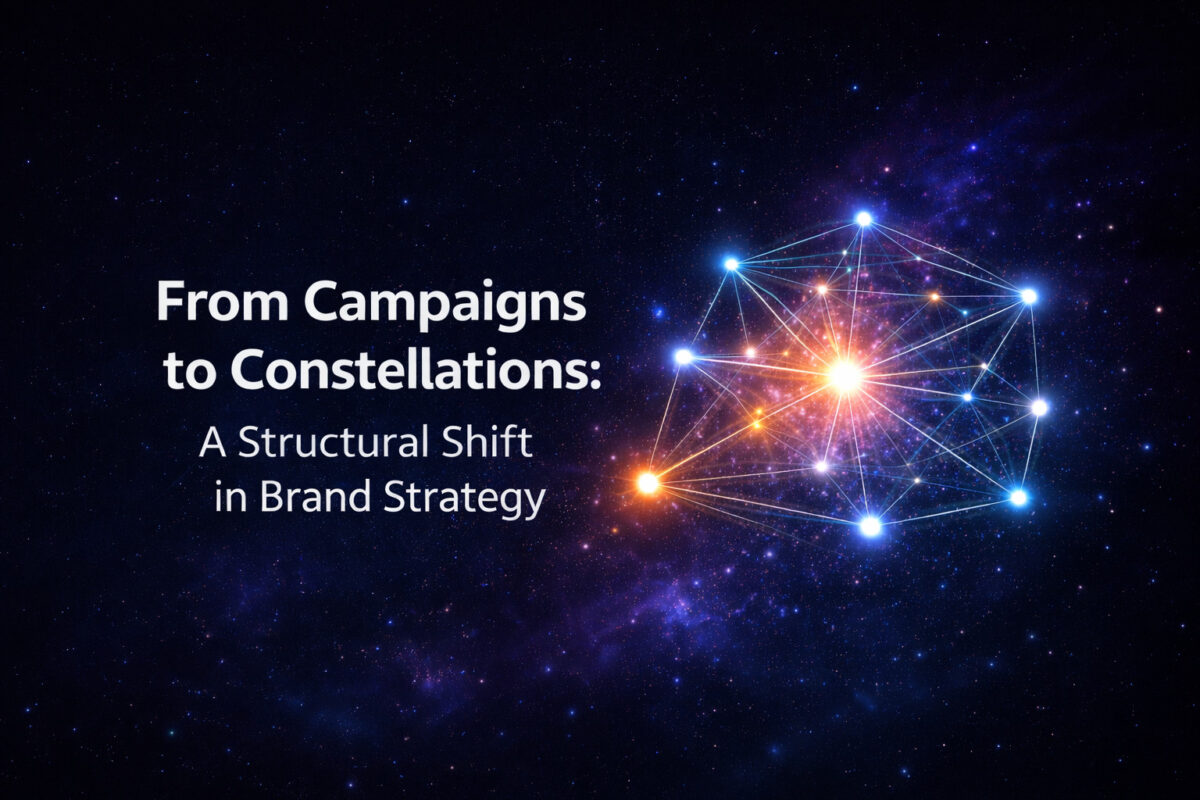
This is where a structural shift is required.

Brand strategy cannot be treated as a linear process that ends with a campaign. It must be treated as a system of meaning shaped by interconnected decisions.

This is the logic behind Brand Constellations.

Rather than optimizing individual elements in isolation, Brand Constellations focuses on how meaning is formed through interaction—across offering, pricing, availability, competitive context, company behavior, and customer interpretation.

No single element defines the brand.
Meaning emerges from their alignment over time.

This is not a new layer of branding.
It is a different unit of analysis.

Campaigns vs. Constellations

Campaigns are episodic.
Constellations are cumulative.

Campaigns assume control.
Constellations acknowledge interpretation.

Campaigns focus on what is said.
Constellations focus on what is reinforced.

In a constellation, strength does not come from excellence in one area. It comes from coherence across many.

When decisions reinforce the same underlying idea, the brand feels clear without explanation.

When they don’t, no campaign restores clarity.

What Changes When You See Brand This Way

The central question of brand strategy shifts.

It is no longer:
“What should we say?”

It becomes:
“What is everything we do teaching the market?”

That question moves brand upstream—from communications to decisions, from marketing to leadership, from projects to systems.

It also explains why brand strategy cannot be owned by a single function. Meaning is being created whether it is managed or not.

Brand Constellations doesn’t add complexity.
It makes existing complexity visible—and workable.

This Is an Evolution, Not an Alternative

This shift does not reject creativity, storytelling, or campaigns.

It puts them in the right place.

Campaigns are most effective when they sit downstream of aligned decisions—when they reflect a constellation that already makes sense.

In fragmented markets, coherence is the advantage.
In noisy environments, alignment is the signal.
In competitive categories, meaning is the differentiator.

Moving from campaigns to constellations is not a trend.

It is a structural response to how brands are actually perceived today.

And once you see brand this way, it becomes very difficult to unsee it.

From Campaigns to Constellations: A Structural Shift in Brand Strategy

From Campaigns to Constellations: A Structural Shift in Brand Strategy

For decades, brand strategy has been treated as a marketing problem.

When results lag, the instinct is predictable: refresh the messaging, clarify the positioning, launch a new campaign. The assumption is that if the story is compelling enough, everything else will fall into place.

But increasingly, it doesn’t.

Brands invest more in marketing than ever, yet struggle with weak differentiation, price pressure, internal misalignment, and confused customers. The problem isn’t marketing effort. It’s brand structure.

Most brand strategies are built for a world that no longer exists.

The Campaign Mindset—and Its Limits

Traditional brand strategy is largely linear. It assumes that brand meaning is created by selecting the right message and delivering it across channels. Product, pricing, distribution, and internal behavior are treated as inputs to support the campaign.

This mindset made sense in a mass-media environment where communication was one-directional and tightly controlled. Brands spoke. Markets listened.

That world is gone.

Today, customers don’t encounter brands through a single narrative arc. They experience them through decisions: what’s offered, how it’s priced, where it’s available, how the company behaves, and how all of that compares to alternatives. These signals arrive simultaneously, not sequentially.

And people don’t interpret them one at a time.

They integrate them.

How Brand Meaning Actually Forms

When people think about a brand, they don’t recall a tagline and then reason forward. They recognize a whole. An object. A pattern of meaning that feels coherent—or doesn’t.

This matters because recognition is holistic. Customers don’t experience brands touchpoint by touchpoint. They experience brands as systems.

That means brand meaning is not created by campaigns alone. It emerges from the alignment—or misalignment—across the decisions an organization makes over time.

Messaging can amplify meaning, but it cannot create coherence where none exists.

This is where most brand strategies break down.

Fragmentation Is a Structural Problem, Not a Creative One

When brands feel “confused” in the market, it’s rarely because the message is unclear. More often, it’s due to organizational decisions failing to support the same idea.

A product positioned as premium but priced tactically.
A company that claims customer centricity but designs for internal efficiency.
A bold category narrative undermined by conservative operational choices.

Each decision makes sense in isolation. Together, they fragment meaning.

The result is familiar: marketing works harder, sales cycles lengthen, teams argue about positioning, and leadership feels pressure to “do more branding.”

What’s missing is not activity. It’s alignment.

From Linear Thinking to Systems Thinking

This is where a structural shift is required.

Instead of treating brand as a linear process—strategy to message to execution—we need to treat brand as a system of meaning shaped by interconnected decisions.

This is the logic behind Brand Constellations.

Rather than optimizing individual elements in isolation, Brand Constellations views brand as a whole formed by multiple sources of meaning operating together. Product, placement, pricing, promotion, category framing, competitive context, company behavior, and customer interpretation all contribute simultaneously.

No single element creates the brand. Meaning emerges from their interaction.

This is not a checklist. It’s a way of seeing.

Why Constellations, Not Campaigns

Campaigns are episodic.
Constellations are cumulative.

Campaigns assume control.
Constellations acknowledge interpretation.

Campaigns focus on what is said.
Constellations focus on what is reinforced.

In a constellation, strength doesn’t come from excellence in one area. It comes from coherence across many. When decisions reinforce the same underlying idea, the brand feels clear without explanation. When they don’t, no campaign can compensate.

This is why some brands feel inevitable, while others feel busy.

The Practical Implication for Brand Strategy

Adopting a constellation mindset changes the work of brand strategy fundamentally.

The core question is no longer:
“What should we say?”

It becomes:
“What is everything we do teaching the market?”

That shift moves brand upstream from communications to decisions, from marketing to leadership, from projects to systems.

It also explains why brand strategy cannot be owned by a single function (i.e., marketing). Brand meaning is shaped across the organization, whether intentionally or not.

Brand Constellations doesn’t add complexity. It reveals it and makes it manageable.

A Necessary Evolution, Not an Alternative

This is not about replacing creativity, storytelling, or execution. It’s about putting them in the right place.

Campaigns still matter. Messaging still matters. Promotion still matters.

But they work best when they sit downstream of aligned decisions, when they reflect a constellation that already makes sense.

In a fragmented market, coherence is the advantage.
In a noisy environment, alignment is the signal.
In a world of constant choice, meaning is the differentiator.

Moving from campaigns to constellations is not a trend.
It’s a structural response to how brands are actually perceived today.

And once you see brand this way, it becomes very difficult to unsee it.


Unlocking Brand Clarity: The Key to Consistency and Meaning

In the ever-evolving landscape of business, brand clarity serves as a fundamental pillar that supports both a strong identity and effective communication. Understanding the significance of brand clarity can significantly enhance how your audience perceives and engages with your brand.

As expressed in a recent discussion, “Clarity actually unlocks consistency and meaning in people’s minds in the market.” This profound statement encapsulates the essence of brand clarity. When consumers possess a clear understanding of what your brand represents, it fosters consistency in their perceptions and interactions. A well-defined narrative not only strengthens brand identity but also makes it easier for your audience to connect with your offerings.

When brand clarity is lacking, however, the consequences can be detrimental. In these instances, potential customers may seek information from competitors or other external sources, diluting the unique attributes of your brand. The message becomes muddled, and the opportunity to convey your brand’s story is lost.

Thus, it is essential for businesses to cultivate a consistent story. This narrative should resonate with the core values and mission of the brand, ensuring that every communication aligns with this foundation. Whether through visual identity, messaging, or customer interactions, maintaining brand clarity should be a priority for every organization.

To unlock the full potential of your brand, prioritize establishing clarity. It will not only lead to enhanced consistency but also create a meaningful connection with your audience, ultimately elevating your brand above the competition.

Brand Strategy Is Not Optional: Start Now

When growth is your top priority, it is easy to treat branding as something to “get to later.” In the early stages, product development, sales, hiring, and funding naturally take center stage.

But delaying your strategic branding is like building a rocket without navigation. It might fly, but not where intended.

A brand is more than logos and slogans. It drives how you invest in marketing to influence perceptions among customers, employees, investors, and the market.

Clear and consistent branding is crucial for marketing investment, sustained growth, and long-term value.

Brand Drive Business Success

Strong brands do not just win attention. They win trust, loyalty, and margin. They illuminate your values, simplify your message, and foster emotional engagement, maximizing your marketing ROI.

How does brand investment pay off for your organization?

  • Accelerated Sales: Clear and memorable branding drives sales by highlighting your value. This lessens dependence on the founders for sales and provides marketing and sales teams with consistent communication.
  • Higher Pricing Power: Branding helps position your product beyond features. Customers who appreciate your unique value proposition are less inclined to negotiate price.
  • Talent Magnetism: Your brand image influences potential hires as much as it does your customers. Mission, culture, and vision matter—especially to top talent.
  • Investor Confidence: A powerful brand story shows a clear vision and market dominance. This shows investors your expertise and proven ability to win.
  • Marketing Efficiency: A clear brand makes your marketing work harder. Without it, campaigns risk being inconsistent, fragmented, or forgotten.

In short: a well-aligned brand isn’t a nice-to-have—it’s a force multiplier.

The Risks of Not Investing in Brand Early

Strong branding drives growth. Weak branding undermines it. Companies that delay brand investment often encounter:

  • Market Confusion: Without a clear position, prospects struggle to understand what makes you different or why they should care. This leads to lower conversion and wastes ad spend.
  • Internal Misalignment: Product, marketing, sales, and customer success may develop their own messages. Working in isolation can send conflicting messages and undermine performance.
  • Commoditization: If you do not define your difference, the market will define it for you. Often that means competing on price in a race to the bottom.
  • Investor Friction: Unclear branding may deter investors, who see weak positioning as a major hurdle for growth and eventual sale.
  • Lower Exit Multiples: A strong brand is a key asset sought after in acquisitions. A poorly articulated or inconsistently executed brand can directly impact your valuation.

Delaying brand clarity increases costs and lost opportunities.

What Strategic Branding Really Means

Branding is not just your logo, fonts, or website layout. Strategic branding is about your intention. What do you want your brand to mean in the market’s mind? How do you align what you say, what you sell, and what you stand for?

At Brand Constellations LLC, we define this alignment across eight essential dimensions:
Product, Price, Placement, Promotion, Category, Competitors, Company, and Customers.

Brand strategy should be integrated into the key decisions represented by each dimension. The framework ensures consistent messaging that reflects your values, sets you apart from competitors, and connects with your ideal customer.

A powerful brand strategy provides the essential framework for your go-to-market strategy.

How to Know It’s Time to Invest in Brand

Here are signs you’re ready—or overdue—to take brand seriously:

  • You are hiring marketing or sales leadership but don’t have clear messaging they can build on.
  • Your offering is technically strong, but your market traction is flat.
  • You are preparing for a funding round or strategic exit and need to strengthen positioning.
  • Different teams are describing your company or product in different ways.
  • Prospects often ask “What exactly do you do?” or “How are you different?”

If any of these situations apply to you, don’t delay.

How to Invest Wisely in Brand

Creating brand strategy does not mean hiring a creative agency to “make it pretty.” It means aligning your leadership team around who you are, what you offer, and why it matters. This alignment informs decisions about all dimensions including product, pricing, messaging, customer experience, and marketing.

Here are three smart ways to begin:

  1. Assess Brand Alignment Across the 8 Dimensions: Use a structured framework like Brand Constellations to diagnose inconsistencies and surface opportunities.
  2. Prioritize Strategic Differentiation: Go beyond competition. Establish your own distinct category. This boosts perceived value and strengthens the competitive advantage.
  3. Build Brand Into Growth Planning: Let your brand strategy guide growth choices, focusing on customer targeting, product planning, and partnerships.

Build a Brand for Growth

For growth companies, the question is not whether you’ll invest in brand. It’s when and how. Investing early ensures that your growth is not just fast, but focused, aligned, and valuable.

A strong brand isn’t a cost center. It is an asset that appreciates over time and influences every aspect of our business, from pricing to hiring and sales.

Brand clarity is growth clarity. Build it now before you scale confusion.

Apple’s $1.3T Brand Equity: The Power of Strategic Alignment Through the Brand Constellations Framework

The 2025 BrandZ report from Kantar is out and Adweek reports that “At $1.3 trillion, Apple’s brand value has risen 28% year-over-year.” Why is Apple so valuable? This article examines the reasons behind its consistent ranking as a top global brand, renowned for premium products, innovative designs, and exceptional customer loyalty.

But what exactly makes Apple’s brand so powerful? By analyzing Apple through the Brand Constellations Framework, we can uncover the strategic alignment that has propelled it to global dominance.

Product: The Cornerstone of Apple’s Brand Equity

Apple’s products are synonymous with sleek design, advanced technology, and user-centric functionality. Each product is meticulously developed to reflect Apple’s core values of simplicity and sophistication. From iPhones and MacBooks to Apple Watches, Apple positions its entire product line as premium, aiming for a superior user experience.

How This Drives Brand Equity

Apple’s focus on quality and innovation not only fosters strong brand associations but also commands premium pricing. Apple’s superior design, functionality, and user experience justify the premium price customers are willing to pay. This strategy reinforces Apple’s positioning as a luxury tech brand, driving both customer loyalty and higher profit margins.

Placement: The Branded Experience

Apple’s approach to placement is all about control and consistency. Apple Stores are more than just retail outlets—they are immersive brand experiences. Apple’s brand is reflected in every detail, from the minimalist design to the expert staff. Even online, the shopping experience is seamless and aligned with the brand’s aesthetic.

How This Drives Brand Equity

By maintaining strict control over its retail environment, Apple ensures that every interaction with its products is a branded experience. This level of consistency strengthens brand recall and reinforces Apple’s image as a premium, aspirational brand.

Price: The Power of Perception

Apple’s pricing strategy is deliberate and strategic. The products command a higher price point than competitors, reinforcing their luxurious image and exclusivity. This strategy sets Apple apart from cheaper competitors, conveying both quality and innovation.

How This Drives Brand Equity

The perception of exclusivity fosters brand loyalty and allows Apple to maintain high profit margins. Apple cultivates a premium brand image by positioning its products as quality investments that convey status, thus commanding consistently higher prices.

Promotion: Building Emotional Connections

Apple’s promotional strategies focus on storytelling and emotional appeal. The marketing campaigns aim to inspire feelings of aspiration, creativity, and connection. Apple ads rarely focus on technical specifications. Instead, they highlight how products fit seamlessly into a creative, forward-thinking lifestyle.

How This Drives Brand Equity

Apple cultivates a powerful brand identity and community by prioritizing emotional connections over product features. Customers don’t just buy Apple products. Customers connect with the brand’s lifestyle, becoming loyal advocates who naturally promote it.

Category: Redefining the Market

Instead of just joining existing markets, Apple reshapes them. iPhones revolutionized mobile phones, iPads redefined personal computing, and Apple Watches set a new standard for wearables. Apple strategically positions itself as a leader and innovator in every category it enters.

How This Drives Brand Equity

Apple’s reputation as a market leader and its significant market share are both products of its consistently high standards. The company’s leading position strengthens its brand and leaves the competition trailing.

Competitors: Standing Out in a Crowded Market

Apple’s strategic differentiation from competitors such as Samsung and Google lies in its emphasis on brand experience rather than technical details. Instead of competing on price, Apple focuses on quality, design, and a seamless ecosystem.

How This Drives Brand Equity

Apple’s differentiation strategy solidifies its premium brand image, justifying higher prices without losing market share. The high quality of Apple products results in strong customer loyalty and advocacy.

Company: Cultivating Internal Alignment

Innovation and excellence are core to Apple’s internal culture. Apple’s internal workings, from the design labs to the executive suites, reflect its external brand image. Its leadership consistently reinforced the brand’s commitment to quality and innovation.

How This Drives Brand Equity

Internal alignment ensures that every product, marketing campaign, and customer interaction is on-brand. This consistency solidifies Apple’s reputation as a brand that delivers on its promises, enhancing credibility and consumer trust.

Customers: The Heart of Apple’s Strategy

More than just products, Apple forges customer relationships. The company uses customer data to personalize experiences, build community, and encourage loyalty. Apple’s ecosystem and AppleCare strengthen customer relationships, making the brand essential in daily life.

How This Drives Brand Equity

Apple’s customer-centric approach fosters brand loyalty. Apple’s loyal customer base not only makes repeat purchases but also recommends the brand to others, extending its reach and solidifying its market dominance.

Why Apple’s Brand Equity Is So High

Apple’s powerful brand results from a well-executed and consistent brand strategy on all eight dimensions of the Brand Constellations Framework. Apple maintains its premium brand through strategic product, pricing, and customer management.

Apple’s success offers a powerful lesson in brand alignment for brands aiming for a stronger market position and sustainable growth. Using the Brand Constellations Framework, businesses can consolidate their marketing strategies for stronger brands and better market results.

Beware of the Gap Between Your Internal Culture and External Brand Promise

Many executives focus their branding efforts on external messaging and how customers and competitors see their company. However, a critical branding issue, often ignored, is the internal alignment of operations and culture with the brand’s outward image.

A gap between a company’s internal practices and its public image destroys consumer trust. Employees feel the company is hypocritical, customers see inconsistencies, and stakeholders doubt the brand’s authenticity. This lack of alignment hurts productivity, employee morale, customer loyalty, and your brand’s value.

Why Does Internal and External Alignment Matter?

Your brand isn’t merely what you say it is. It’s what you consistently do and deliver. The Brand Constellations Framework underscores this point with its “Company Star,” emphasizing the importance of internal alignment for successful branding.

Companies like Patagonia illustrate this principle perfectly. Patagonia’s marketing goes beyond sustainability. It lives the value internally through sustainable business practices and activism. This creates a strong, reliable brand that both employees and customers support.

Identifying Symptoms of Misalignment

Recognizing internal-external misalignment requires honest reflection. Here are common indicators:

  • Employees are unsure of or disconnected from the brand’s values.
  • Customer feedback regularly points to unmet expectations.
  • There’s a noticeable difference between marketing messages and actual customer experiences.
  • Employee turnover is high, and morale is consistently low.

Creating Alignment Through the Brand Constellations Framework

Achieving genuine alignment starts by clearly defining and internalizing your brand’s core values and mission:

  1. Define Clear Values: Clearly articulate your brand’s core principles, ensuring they are meaningful and actionable internally.
  2. Communicate Consistently: Regularly reinforce your values internally through clear, consistent communication from leadership down to all levels of employees.
  3. Lead by Example: Leaders must embody the values publicly and internally. Authentic leadership drives alignment and motivates teams.
  4. Evaluate and Adjust Operations: Regularly assess if your processes and practices align with your external brand messaging. Adjust operational strategies to close any gaps.

Turning Alignment into Strategic Advantage

Aligning internal operations with external commitments builds authenticity, a key competitive advantage. Employee brand advocacy builds customer trust and enhances your company’s reputation, attracting better talent, stronger partnerships, and customer loyalty.

Authenticity is a premium currency. Matching your internal culture to your brand promise streamlines operations and creates a stronger, more resilient, and valuable brand. The time for alignment is now. Don’t let misalignment undermine your brand’s potential.

Unlocking Brand Potential: Why Internal-External Alignment Matters

Is your company saying one thing and doing another? When your internal culture doesn’t match your brand image, it damages customer trust, creates confusion, and weakens your brand.

In my latest article, I explore why aligning internal practices with external messaging is essential for building a strong, authentic brand. Discover key strategies for closing the gap and turning alignment into a powerful competitive advantage. Read more to learn how the Brand Constellations Framework can guide you toward a brand that’s as consistent inside as it is outside.

Branding Implications of Tariffs

Tariffs—especially when newly introduced—don’t just affect trade. They ripple across branding decisions and customer perceptions. Using the Brand Constellations Framework (Product, Placement, Price, Promotion, Category, Competitors, Company, Customers), we can uncover how tariffs reshape brand strategy and what companies must do to maintain brand clarity and alignment.

1. Product

Implications: Tariffs often increase costs of raw materials or components, which may:

  • Force substitutions that change product quality or features.
  • Require shifts to new suppliers that disrupt continuity.

Brand Risk: Customers notice when the product feels different or diminished—especially if you don’t explain why.

Brand Move: Use this as a moment to reframe the product narrative. Highlight quality, sourcing transparency, or resilience.

2. Placement

Implications: Tariffs can strain distribution strategies by:

  • Increasing costs to move goods across borders.
  • Delaying access to international markets.

Brand Risk: Gaps in placement create friction for customers, especially when expectations aren’t reset.

Brand Move: Shift messaging to emphasize domestic availability or direct-to-consumer options. Communicate clearly about changes in access.

3. Price

Implications: Cost increases from tariffs may force:

  • Higher prices to preserve margins.
  • A squeeze on pricing flexibility in competitive markets.

Brand Risk: Without strategic framing, price hikes can feel arbitrary or opportunistic.

Brand Move: Reinforce the value story. If the price must go up, so must clarity around what the customer is paying for (e.g., durability, ethics, supply resilience).

4. Promotion

Implications: Marketing must now:

  • Explain changes (in product, price, or availability) clearly.
  • Potentially shift tone toward themes like resilience, independence, or support for domestic supply chains.

Brand Risk: Silence, vagueness, or tone-deaf messaging will damage trust.

Brand Move: Be transparent. Use this moment to communicate brand values—especially around supply ethics, sustainability, or national loyalty if relevant.

5. Category

Implications: Tariffs may push your brand into a new category context:

  • Formerly “value” brands may now feel premium-priced.
  • Domestic brands may redefine the “authentic” or “trusted” tier.

Brand Risk: Customers re-categorize your brand before you do, leading to confusion or rejection.

Brand Move: Take control of the category narrative. Redefine what “value,” “premium,” or “trusted” means in this new context.

6. Competitors

Implications: Some rivals may benefit:

  • Domestic competitors avoid cost increases.
  • Agile brands may pivot sourcing faster.

Brand Risk: Falling behind creates perception of weakness or indecision.

Brand Move: Differentiate on stability, trust, or innovation—not just cost. Promote what you’ve done proactively, not reactively.

7. Company

Implications: Tariffs challenge leadership to:

  • Make tough decisions on sourcing, hiring, pricing.
  • Hold together internal brand understanding and purpose.

Brand Risk: Employees may feel disconnected if changes aren’t explained or aligned with mission.

Brand Move: Reaffirm the company’s brand promise internally. Use purpose and principles as a compass for adapting externally.

8. Customers

Implications: Customer reactions will vary:

  • Some may support domestic-first changes.
  • Others will resist higher prices or availability issues.

Brand Risk: Failing to anticipate shifts in customer expectations can erode loyalty.

Brand Move: Use direct communication, listening, and education to reinforce brand trust. Elevate customer-centric clarity over defensive explanations.

Keep Your Brand Aligned

Tariffs stress-test your brand’s alignment.
They force companies to make visible trade-offs—on price, product, promotion, and placement—that customers will notice.

Using the Brand Constellations Framework, brands can navigate this change with strategic coordination across all dimensions. The goal isn’t just to react. It’s to align—and reassert a brand identity that is clear, consistent, and resilient.

If you align the constellation, you can turn confusion into clarity—and disruption into differentiation.

If Customers Are Confused, Your Brand Isn’t Broken—It’s Misaligned

When brand growth slows, marketing campaigns fall flat, or customer loyalty fades, it’s easy to assume something fundamental is broken.

But most brands aren’t broken.
They’re misaligned.

Misalignment: The Root Cause of Customer Confusion

Brand misalignment occurs when product promises, pricing, and marketing contradict each other.

This drift fractures the customer experience.
And, confused customers don’t pause to figure you out—they simply move on.

The solution isn’t louder marketing.
It’s strategic alignment.

At Brand Constellations LLC, we use the Brand Constellations Framework to align eight brand dimensions: Product, Placement, Price, Promotion, Category, Competitors, Company, Customers.

When these dimensions form align to form a consistent Brand Constellation, they create Brand Clarity: the gravitational force that attracts understanding, trust, and choice.

Why Alignment Drives Brand Clarity

Research supports this: clear and consistent brand signals reduce perceived risk, enhance trust, and drive purchase behavior.

Meanwhile, fragmented branding leads to confusion, customer hesitation, and lost opportunity.

Alignment creates Clarity.
Clarity builds Trust.
Trust drives Choice.
Choice drives Growth.

Brand Constellations in Action: Analysis Across Eight Dimensions

Let’s see how three strong brands create alignment—and Brand Clarity—across all eight dimensions.

🔥 Patagonia

  • Product: Sustainable outdoor apparel and gear.
    → Product durability and eco-conscious design reinforce brand purpose.
  • Placement: Specialty retailers, brand-owned stores, and direct-to-consumer channels emphasizing values-based shopping.
  • Price: Premium pricing reflects quality, ethics, and commitment to sustainability.
  • Promotion: Storytelling centered on activism, conservation, and consumer responsibility. Campaigns like “Don’t Buy This Jacket” amplify the mission.
  • Category: Redefined outdoor apparel to integrate environmental activism into consumer choice.
  • Competitors: Differentiates sharply from competitors by positioning activism—not fashion—as core to the brand.
  • Company: Internally aligned around social and environmental responsibility, including donating 1% of sales to environmental causes.
  • Customers: Outdoor enthusiasts, activists, and values-driven consumers who want their purchases to reflect their ethics.

Result: Patagonia’s brand constellation forms a complete, aligned narrative. Every touchpoint reinforces a singular meaning.

💧 Liquid Death

  • Product: Canned mountain water.
    → Simple, pure product turned into a lifestyle symbol with edgy branding
  • Placement: Sold in unconventional outlets (concert venues, skate shops) and major retailers, disrupting traditional bottled water shelves.
  • Price: Premium price compared to typical bottled water, positioning water as a “cool” purchase rather than a commodity.
  • Promotion: Wild, rebellious marketing campaigns (“Murder Your Thirst”) that parody heavy metal culture.
  • Category: Redefines bottled water as a lifestyle product rather than a health necessity.
  • Competitors: Differentiates by rejecting the “purity” and “wellness” narratives of traditional water brands like Evian or Smartwater.
  • Company: Culture built around humor, rebellion, and subverting expectations. Employees are encouraged to “embrace weirdness.”
  • Customers: Young, edgy, health-conscious consumers who want healthier options without sacrificing personal style.

Result: Liquid Death’s constellation is sharply defined. Its clarity fuels viral growth and deep brand loyalty.

👓 Warby Parker

  • Product: Stylish eyeglasses offered at a fraction of traditional retail prices.
  • Placement: Online-first, with select physical stores in high-traffic urban centers.
  • Price: Transparent, affordable pricing—around $95 per pair—undercutting traditional optical retail.
  • Promotion: Friendly, accessible messaging emphasizing simplicity, affordability, and giving back.
  • Category: Created a new direct-to-consumer category for designer eyewear.
  • Competitors: Differentiates from luxury optical brands (e.g., Luxottica) and discount providers by offering both style and affordability.
  • Company: Internally mission-driven, with initiatives like the “Buy a Pair, Give a Pair” program for global vision care.
  • Customers: Millennials and Gen Z professionals seeking affordable, stylish, socially responsible choices.

Result: Warby Parker’s brand constellation aligns pricing, purpose, and product into a brand that customers immediately understand and trust.

When Alignment Breaks, Brands Drift

The opposite is also true.

  • WeWork’s collapse was fueled by brand drift: from “community-first startup spaces” to “real estate empire” to “wellness lifestyle brand,” it confused both customers and investors.
  • Tropicana’s infamous 2009 packaging change stripped away critical brand signals (the orange with a straw), creating customer confusion and a 20% sales drop.

When the brand constellation drifts out of focus, even strong brands suffer quickly.

Align to Create Clarity in Your Brand

If customers are confused, your brand isn’t broken—it’s misaligned.

To create lasting Brand Clarity:

  • Align your Product with your Promise.
  • Align your Price with your Positioning.
  • Align your Promotion with your Purpose.
  • Align your Placement with your Customer‘s habits.
  • Clarify your Category, Company Values, and Competitive Differentiation.

The Brand Constellations Framework makes this visible, actionable, and fixable.

Because when your constellation aligns, your brand shines.

And when your brand shines clearly, customers don’t hesitate—they choose.

#branding #brandstrategy #brandclarity #brandconstellations #marketingstrategy #brandalignment #b2bmarketing #growthstrategy